• Welcome to HowTimely 

    The Erasmus+ project "Handling Our Wor(l)ds in Translation: Intersemiotic strategies for Minority and Endangered Languages’ promotion among Youngers" aims to promote the revitalization of Minority and Endangered Languages (MELs) among young people, particularly in secondary schools. The project focuses on using Intermedial/Audio-visual Accessibility & Translation (AVAT) strategies as an innovative pedagogical tool. It intends to counter the decline in the use of MELs and their underrepresentation in the media, especially among teenagers.

    Main Objectives: The project's General Objectives (GOs) are:
     
    • Promote linguistic diversity and the transmission and revitalization of MELs.
    • Dynamize MEL teaching in secondary schools within an inclusive education framework.
    • Promote innovative teaching methods and communication among MEL teachers across Europe.
    • Utilize digital tools to create and share pedagogical activities with the community of MEL teachers.
    • Questionario Italiano/Sardo
      Link to copy in browser:
      https://forms.office.com/e/hGuPe5Cq2y
      Vai al questionario
      Qüestionari català
      Link to copy in browser:
      https://forms.office.com/e/aw6TF7stmm
      Vai al questionario
    • UNIVERSITÀ DEGLI STUDI ROMA TRE
      UNIVERSITAT DE VIC
      DUBLIN CITY UNIVERSITY
      Associació Linguapax International
      CONVITTO NAZIONALE CANOPOLENO SASSARI
      INSTITUTO ALEXANDRE DE RIQUER
      Coláiste Ghlór na Mara
    • HOW TIMELY is an Erasmus+ project addressing the challenge of the decline in the usage of Minority and Endangered Languages (MELs) among young people, particularly within secondary education. It also tackles their underrepresentation in media accessible to teenagers. The project proposes an innovative pedagogical approach based on Intermedial/Audio-visual Accessibility & Translation (AVAT) techniques, such as subtitling, revoicing (voice-over and dubbing), and audio description, as a tool for teaching and revitalizing MELs.

      The general objectives (GO) include promoting linguistic diversity and the transmission and revitalization of MELs, dynamizing MEL teaching in secondary schools within an inclusive education framework, promoting innovative teaching methods and communication among MEL teachers across Europe, and using digital tools to create and share pedagogical activities.

      The project involves a consortium of 7 partners from 3 member states: Italy, Spain, and Ireland. The partners are three universities (Università degli Studi Roma Tre as the applicant, Fundació Universitària Balmes - UVIC, and Dublin City University - DCU), three secondary schools (Convitto Nazionale Canopoleno Sassari, Instituto Alexandre de Riquer, and Coláiste Ghlór na Mara), and one NGO (Associació Linguapax International). Initially, the project focuses on Catalan, Irish, and Sardinian languages, with plans to expand to other MELs after piloting.

      The core methodology involves students translating copyright-free video content from English or the dominant language into their regional MEL, fostering linguistic and transversal skills such as critical analysis, digital competence, and awareness of sensory disabilities.

      The project is structured into five Work Packages (WPs): Project Management (WP1, led by Roma Tre), Teacher Survey and Training (WP2, led by UVIC), Pedagogical Framework and Activities (WP3, led by DCU), Implementation and Assessment (WP4, led by Convitto Nazionale Canopoleno Sassari and supervised by Roma Tre), and Communication and Dissemination (WP5, led by Linguapax).

      Key expected results (Outputs) include:

       HOW TIMELY teaching/training portal (Moodle-based) integrating a training portal for teachers and a virtual classroom with ready-to-use AVAT activities for MELs.

       Good Practices Guide on using AVAT in MEL teaching.

      Suite of pedagogical materials, tasks, and assessment measures adaptable for various MELs.

      Assessment toolkit for metacognitive reflection.

      • Collaborative open-access volume on AVAT in MEL teaching and revitalization.

      The pedagogical activities and platform will be piloted in partner schools through an eTwinning project. The project aims for sustainability by providing open-access digital resources hosted on existing infrastructure (part of the Rise-Up Horizon project and integrated into the project website, which will remain active).

      The project's total duration is 36 months, starting on 18/12/2024 and ending on 17/12/2027.

      HOW TIMELY promotes inclusion and digitalization by supporting MELs, fostering awareness of sensory disabilities through AVAT, and providing innovative open-source digital tools for education. The dissemination strategy involves targeting teachers, students, academic communities, institutions, and the general public through various channels to ensure broad reach and impact beyond the project's lifespan.
    • PROJECT REF. NO 2024-1-IT02-KA220-SCH-000251047

      Funded by the European Union. Views and opinions expressed are however those of the author(s) only and do not necessarily reflect those of the European Union or the European Education and Culture Executive Agency (EACEA). Neither the European Union nor EACEA can be held responsible for them.

Announcements

Teacher Training start!

by RAFFAELLA LEPRONI -
Teacher Training is starting on the HOW TIMELY Training Portal!
 
The main information on the training is available on UVIC-UCC blog https://mon.uvic.cat/how-timely/ .
The HOW TIMELY Training Portal acts as a virtual classroom offering short courses on different audiovisual accessibility and translation techniques (AVAT), helping to gain basic skills as an amateur audiovisual translator.
Courses are available on the following AVAT modalities:
      • Dubbing and voice over
      • Subtitling
      • Audio description
After completing these introductory courses, participants can continue their training and learn more about Didactic Audiovisual Translation (DAT) and on how to design classroom activities based on AVAT and aimed at practicing minoritized languages.
 
We are starting now with a tutorized pilot group involving mainly teachers participating in HOW TIMELY, and who will implement the methodology in class during the third year of the project, while after the completion of the project, the training will be fully autonomous.
 
The training will run from January 22nd to April 30th, according to the following schedule:
• 22/01 – 25/01: Introduction
• 26/01 – 15/02: Revoicing
• 16/02 – 09/03: Subtitling
• 10/03 – 31/03: Audio Description
• 01/04 – 30/04: Didactic Audiovisual Translation
 
A forum will be moderated by the UVIC team to accompany participants throughout their learning process, address questions, and stimulate discussion among participants.

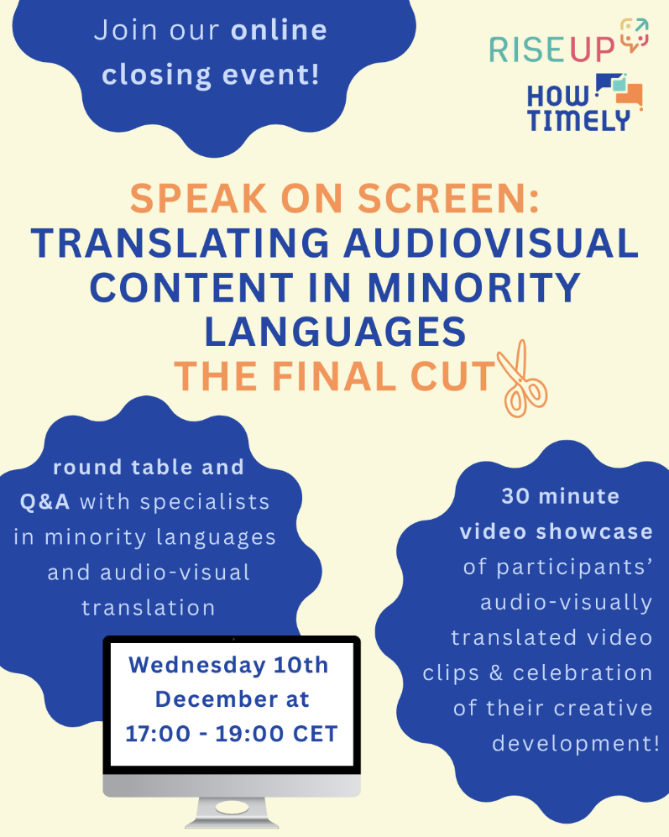
EVENT: Speak on Screen – The final cut

by FRANCESCO AGRUSTI -

Poster Event

“Speak on Screen – The final cut”


Revoicing and subtitling workshop final session followed by a roundtable with specialists in the field of Minority/itized languages and audiovisual translation and media accessibility.


Date and time: Wednesday 10th December 17:00-18:30 CET


17:00-17:30 Showcasing of translated videos and discussion with workshop participants.


17:30-18:30 Roundtable on Minority/itized languages and audiovisual accessibility and translation.


Roundtable moderation:
Mònica Pernya (Linguapax Internacional)


Speakers:
- Cadi Catlow, Stopmotion animator, TALKING PLANET.
- Dr Claudia Martins, Instituto Politécnico de Bragança, Festival de Cinema Acessível.
- Dr Maria Montroy Ferré, Post-doctoral researcher, UJI/UAB.
- Dr Enrique Uribe-Jongbloed, Cardiff University, Vice- Leader of the Plurilingmedia Working Group 1 ‘Audience and content-creator habits’.


Attendance is free but registration is required:
https://uvic-cat.zoom.us/meeting/register/uDmrR-UhTVCwK5XNc-ggzg